
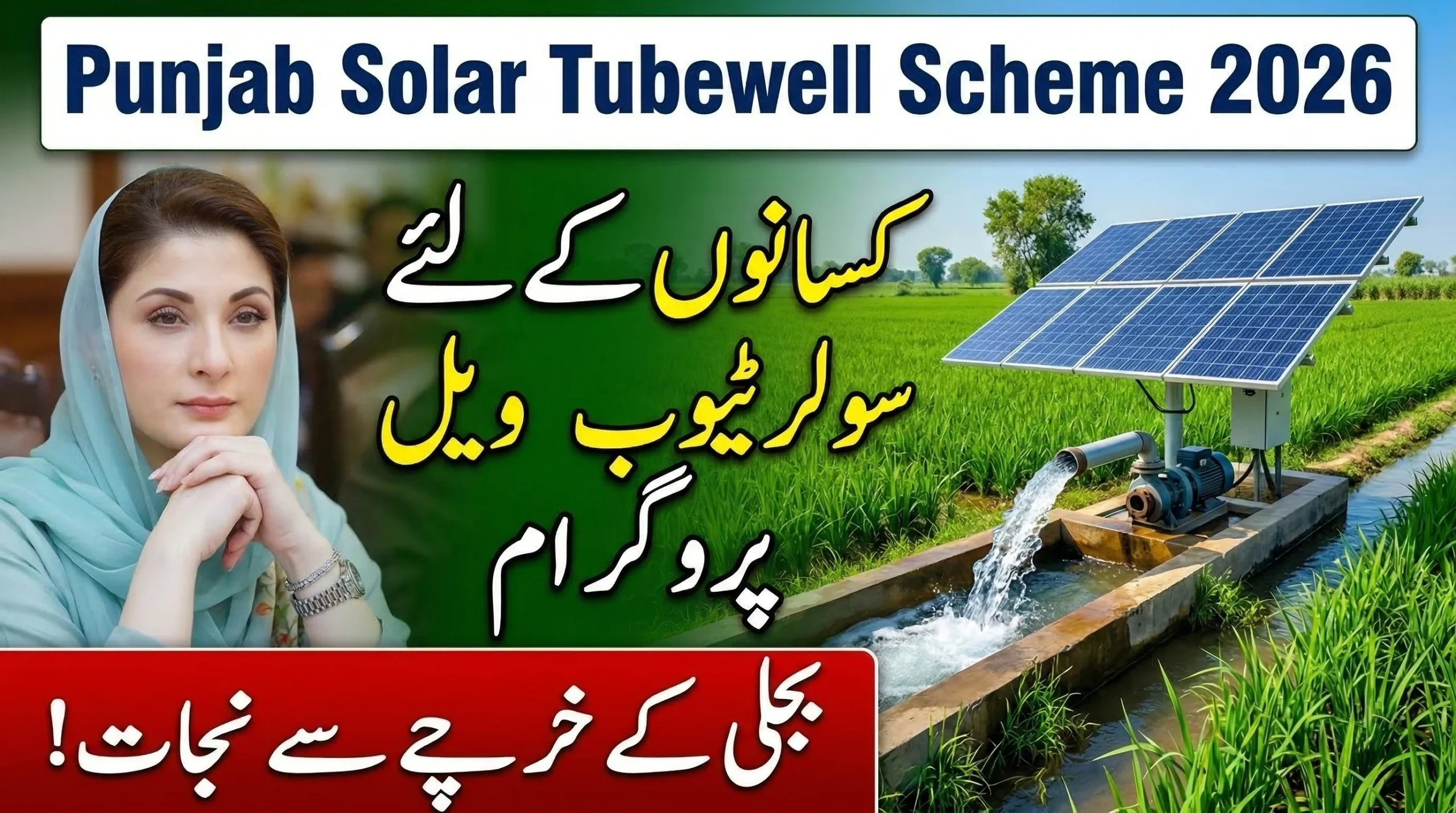
Agriculture remains the backbone of Pakistan’s economy, and Punjab plays a central role in feeding the country. However, rising electricity tariffs, fuel costs, and power shortages have created serious challenges for farmers who rely on tubewells for irrigation. To address this issue, the Punjab Solar Tubewell Scheme 2026 has emerged as one of the most important agricultural initiatives in recent years.

The CM Punjab Solar Tubewell Program aims to help farmers shift from expensive electricity or diesel-powered irrigation systems to solar-powered alternatives. By introducing renewable energy in agriculture, the government hopes to reduce farming costs, improve productivity, and encourage sustainable water management across the province.
Why the Solar Tubewell Scheme Matters
Farmers in many parts of Punjab spend a large portion of their income on electricity bills or diesel fuel to operate their tubewells. In some areas, inconsistent electricity supply also disrupts irrigation schedules, which can affect crop yields.

The solarization of agricultural tubewells in Punjab provides a long-term solution to these challenges. Solar-powered pumps allow farmers to generate their own energy using sunlight, eliminating the need for costly fuel or unreliable grid electricity.
This shift not only supports farmers financially but also contributes to Pakistan’s broader transition toward clean and renewable energy sources.
Key Highlights of the Punjab Solar Tubewell Scheme 2026
Under the new program, thousands of existing tubewells will gradually be converted to solar energy systems. The government is providing significant subsidies to make these systems affordable for small and medium-scale farmers.
Some of the main features include:
- Financial support for installing solar systems on agricultural tubewells
- Reduced irrigation costs for farmers
- Promotion of renewable energy in agriculture
- Improved water management and irrigation reliability
- A transparent application and verification process
The project is part of a broader effort by the Punjab government to modernize agriculture and support farmers facing rising production costs.

Estimated Solar System Support for Farmers
The scheme provides different solar system capacities depending on the size and energy requirements of the tubewell. The table below summarizes the typical categories expected under the program.
| Solar System Capacity | Suitable Farm Size | Estimated Government Support | Main Benefit |
|---|---|---|---|
| 10 kW Solar System | Small farms | High subsidy support | Ideal for low-power irrigation |
| 15 kW Solar System | Medium farms | Major portion covered by government | Reliable water pumping |
| 20 kW Solar System | Large farms | Significant subsidy assistance | Continuous irrigation capability |
These systems help farmers significantly lower operating costs while maintaining efficient irrigation for their crops.
Who Can Apply for the Solar Tubewell Program?
The Solar Tubewell Scheme Pakistan is primarily designed for farmers in Punjab who already operate irrigation tubewells using electricity or diesel.
Typical eligibility criteria may include:
- Residency in Punjab
- Ownership or legal access to agricultural land
- A functioning agricultural tubewell
- Valid identification documents such as CNIC
- Compliance with verification requirements
The final selection process may involve verification of farm details and system requirements to ensure fair distribution of the solar systems.
How Farmers Can Apply
The application process is expected to be simple and accessible to farmers across the province. Interested applicants generally follow these steps:
- Visit the official government portal related to the Punjab Solar Tubewell Scheme
- Submit personal and land ownership information
- Provide tubewell details and energy usage information
- Wait for verification and approval
- Installation of the solar system after selection
Local agricultural departments may also assist farmers in completing their registration and documentation.
Benefits of Solar Tubewells for Agriculture
The introduction of solar irrigation systems offers multiple advantages beyond cost savings. Farmers adopting solar energy can benefit from:

Lower Farming Costs
Solar-powered irrigation removes the need for expensive diesel fuel and reduces electricity expenses.
Energy Independence
Farmers become less dependent on the national power grid and fuel supply fluctuations.
Environmental Sustainability
Solar energy reduces carbon emissions and promotes cleaner farming practices.
Reliable Irrigation
With consistent sunlight in Punjab, solar pumps can provide dependable irrigation throughout the farming season.
Impact on Pakistan’s Agricultural Future
The Punjab Solar Tubewell Project represents a major step toward modernizing the agricultural sector. By integrating renewable energy with farming infrastructure, the government aims to increase productivity while lowering operational costs for farmers.
If implemented effectively, the program could transform irrigation practices across Punjab and serve as a model for other provinces in Pakistan.
The initiative also aligns with global trends where agriculture increasingly relies on clean energy technologies to ensure long-term sustainability.
Final Words
The Punjab Solar Tubewell Scheme 2026 has the potential to significantly change how irrigation works in the province. By supporting farmers with solar-powered systems, the government is addressing two major challenges at once: rising energy costs and the need for sustainable agricultural practices.

For farmers, the program offers an opportunity to reduce expenses, improve crop management, and become more resilient against energy shortages. As renewable energy continues to grow in importance, solar irrigation may soon become a standard part of modern farming in Punjab.
FAQs
What is the Punjab Solar Tubewell Scheme 2026?
It is a government initiative designed to convert traditional agricultural tubewells to solar-powered systems, helping farmers reduce electricity and fuel costs.
Is the solar tubewell completely free for farmers?
The scheme mainly provides significant subsidies from the government. Farmers may still contribute a small portion of the installation cost depending on system capacity.
Who is eligible for the solar tubewell program?
Farmers in Punjab who own agricultural land and operate existing irrigation tubewells are generally eligible to apply.
How can farmers apply for the scheme?
Applications are usually submitted through the official Punjab government portal or agricultural department offices.
What are the benefits of solar tubewells for farmers?
Solar tubewells reduce irrigation costs, provide reliable water pumping, decrease dependence on diesel or electricity, and promote environmentally friendly farming.